
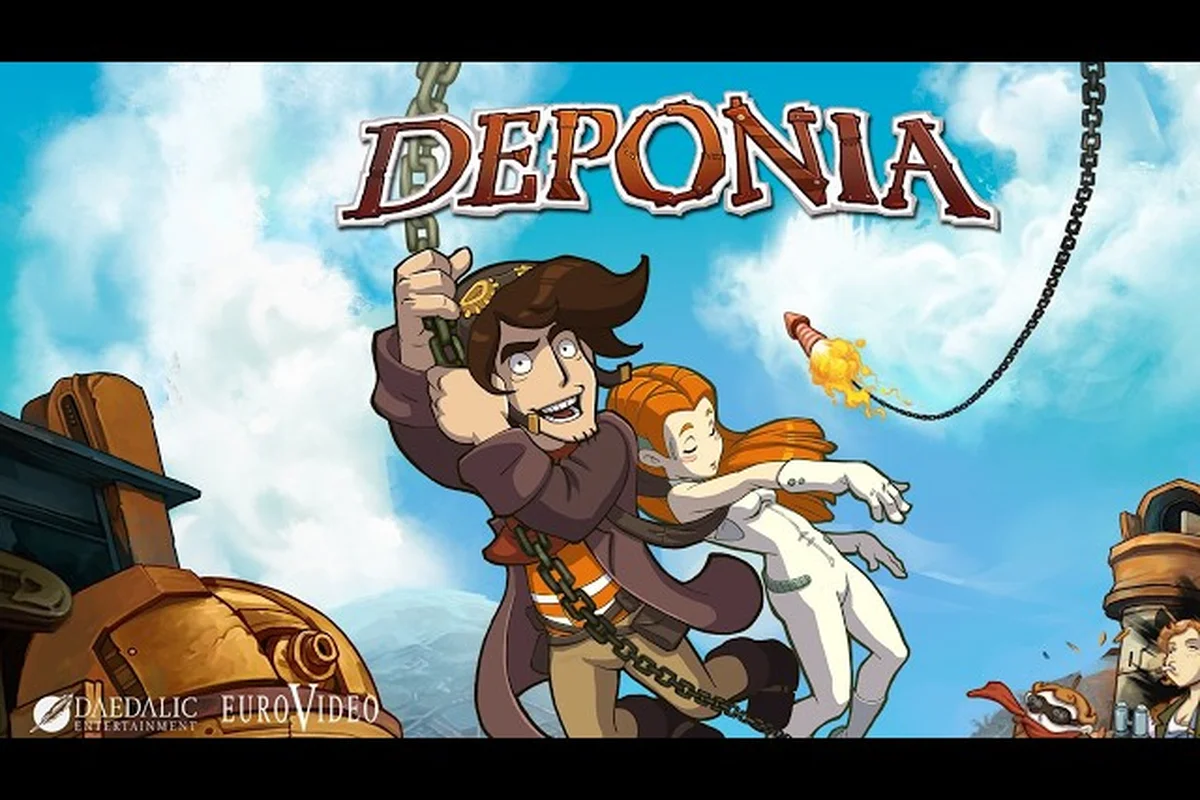
Deponia's gameplay loop is a masterclass in classic point-and-click adventure design, wrapped in a hand-drawn comic aesthetic that still turns heads in 2026. If you're wondering whether this 2012 Daedalic Entertainment title holds up today, the answer is a confident yes — but only if you appreciate deliberate puzzle design and dialogue-heavy storytelling. The core mechanics are simple: left-click to interact, right-click to examine, combine inventory items, and solve environmental puzzles to progress through the garbage-covered planet. That simplicity hides surprising depth, and understanding the deponia gameplay loop before you start will save you hours of frustration.
The game earned a 74/100 Metacritic score on PC, with Steam reviews sitting at Very Positive overall, which tells you the community has largely forgiven its quirks. The real question isn't whether the game is good — it's whether its puzzle logic matches your expectations. This guide breaks down the mechanics, the hint system, the review landscape, and whether the game deserves your time in 2026.
Understanding the Core Deponia Gameplay Loop
The deponia gameplay experience revolves around a classic three-step interaction model that veterans of the genre will recognize instantly. You explore hand-drawn scenes, gather items, and apply them to solve puzzles that gate your progression through the story. The game follows Rufus, an inventor trapped on a planet literally made of garbage, who dreams of escaping to the floating city of Elysium. That premise drives every interaction — you're always working toward the next absurd solution to an even more absurd problem.
The interaction system breaks down into three primary actions: look, use, and combine—the foundational verbs that drive every puzzle in Deponia's point-and-click logic. Looking at an object triggers Rufus's sardonic internal monologue, which often drops crucial deponia hints about item relevance, while using an item on a hotspot (like applying grease to the gondola cable) or combining two inventory objects (such as attaching the plunger to the hose) forms the core cause-and-effect chain. This triad is deliberately minimal, forcing players to experiment with environmental context rather than rely on a sprawling command menu—a design choice that keeps the deponia gameplay loop tight and focused on lateral thinking.
-
Left-click to use objects or talk to characters
-
Right-click to examine items and environments for clues
-
Combine inventory items to create tools or solutions
What separates Deponia from modern adventure games is its commitment to traditional puzzle design. There's no hand-holding, no objective markers, and no quest log telling you where to go next. The game trusts you to figure things out through observation and experimentation, which is both its greatest strength and its most polarizing feature. Players who grew up on LucasArts classics like Monkey Island will feel right at home, while those accustomed to modern QoL features might find the opacity frustrating.
The dialogue system deserves special attention because it's where much of the game's charm lives. Conversations are lengthy, frequently absurd, and packed with character development that makes the puzzle-solving feel meaningful. Rufus is intentionally unlikable — arrogant, lazy, and selfish — but the writing is sharp enough that you'll grow fond of him despite his flaws. According to community reports, players who skip dialogue miss roughly 30% of the game's appeal, since the humor is deeply tied to understanding the characters' motivations.
The Deponia Hints System and Puzzle Difficulty
The Three-Button Input Scheme and Hotspot Scanning
Deponia's core loop relies on a strict three-button scheme: left-click to use or talk, right-click to examine, and middle-click to hold for the hint overlay. Unlike modern adventure games with pixel-hunting mitigations, Deponia expects you to actively scan every scene. A practical case: early in the trash-city of Kuvaq, the wrench needed for the elevator mechanism is hidden behind a pile of scrap that only highlights when you hold middle-click. Master this scanning habit before Chapter 2, where interactive hotspots become deliberately obscured among environmental clutter.
Metacritic Score Breakdown and Platform Disparity
Deponia's reception varies sharply by platform, a critical factor for 2026 buyers. The PC version holds a 74/100 Metacritic score, while the PS4 port drops to 71 and the Switch version falls to 64. This 10-point gap between PC and Switch is largely attributed to load times and control precision—the Switch's touchscreen lacks the right-click examine shortcut, forcing players into a slower menu-based inspection. Critics like GameStar (88/100) and GameSpot (8/10) praised the puzzle design, while GameWatcher's 5/10 highlights the divisive logic of certain inventory combinations.
| Control | Action | Mouse Button | Use Case |
|---|---|---|---|
| Interact / Talk | Use or talk to object/character | Left-click | Primary interaction with hotspots |
| Examine | Inspect object or character | Right-click | Gather descriptions and clues |
| Combine Items | Merge inventory items | Left-click on item, then target | Solve puzzles requiring item assembly |
| Hint System | Reveal interactive hotspots | Hold middle mouse button | Highlight all clickable areas on screen |
The deponia hints system is arguably the most important mechanic for new players to understand, because it directly addresses the game's steepest learning curve. Daedalic implemented a built-in hint system that activates when you hold down the middle mouse button, highlighting all interactive hotspots on screen. This doesn't solve puzzles for you — it simply shows you what you can interact with, which is invaluable when you're stuck on a solution that requires combining items in unexpected ways.
The puzzle difficulty curve is worth examining because it's not linear. The game starts relatively gentle, introducing mechanics through straightforward object-use puzzles, then ramps up significantly in the second half. Some puzzles require multi-step solutions that span multiple screens and involve characters you met hours earlier. This design choice has drawn criticism from players who feel certain solutions are too obtuse, but defenders argue the logic is always internally consistent.
Here's what the puzzle progression looks like in practice: early puzzles in Deponia rely on single-object inventory combinations, but by the time you reach the Elysium-bound ship in Chapter 2, solutions chain 3–4 steps — for example, using the vacuum cleaner on the goat to trigger a chain that requires the crank, the rope, and precise timing on the crane. This ramp mirrors the game's hint system: the first two chapters offer optional context-sensitive clues, but the final act's multi-screen logic puzzles (like the Ulysses' pipe maze) drop hints entirely, forcing you to backtrack across all three Deponia maps to re-examine every inventory item you've hoarded.
| Act | Puzzle Complexity | Hint System Reliance | Estimated Playtime |
|---|---|---|---|
| Act 1 | Low to moderate | Minimal | 2-3 hours |
| Act 2 | Moderate to high | Moderate | 3-4 hours |
| Act 3 | High | Heavy | 3-5 hours |
| Act 4 | Very high | Very heavy | 4-6 hours |
The hint system's hotspot highlighting is a quality-of-life feature that modern adventure games should have adopted more widely. It doesn't remove challenge — you still need to figure out what to do with the highlighted objects — but it eliminates the frustration of pixel-hunting, which was the genre's most criticized element. Community data suggests that players who use the hint system regularly complete the game in 12-15 hours, while those who refuse it can easily spend 20+ hours due to extended stuck periods.
One common criticism from the deponia review community is that certain puzzle solutions require leaps of logic that feel unfair. For example, one early puzzle requires you to use a fish to distract a creature, but the game never explicitly tells you the creature is attracted to fish. Players report that these moments are rare — maybe 3-4 puzzles across the entire game — but they stand out because they break the otherwise consistent internal logic.
Deponia Review Breakdown: What Critics and Players Say
The deponia review landscape is fascinating because it reveals a significant split between professional critics and the player community. The game holds a 74/100 Metacritic score on PC, but individual reviews range from 88/100 to 5/10, which is an unusually wide spread. Understanding this variance helps you calibrate your expectations before diving in.
German outlets were particularly enthusiastic, with GameStar awarding 88/100 and calling it "Lucasarts from Germany!" — a reference to the golden age of adventure games. 4Players gave it 87/100, and GameSpot chimed in with 8/10. On the opposite end, GameWatcher gave 5/10, criticizing the puzzle logic and pacing. This split isn't random — it reflects genuine differences in what players value from the genre.
Critics largely agree that Deponia’s puzzle design is its defining strength, with the majority praising the game’s trademark "inventory logic" — where solutions require combining seemingly unrelated items in ways that defy conventional adventure-game reasoning. Reviewers frequently cite the "tornado" sequence in Chapter 2 as a polarizing example: while some laud its creative, multi-step contraption-building (e.g., attaching a rubber chicken to a fan to create propulsion), others deride it as obtuse pixel-hunting that forces excessive backtracking between Elysium and the junkyard. This split typically breaks down along genre-experience lines, with veteran point-and-click players more forgiving of Deponia’s trial-and-error demands than newcomers, a pattern reflected in the ~75% Metacritic average versus a notably higher 8.5/10 user score on Steam.
| Outlet | Score | Key Praise | Key Criticism |
|---|---|---|---|
| GameStar | 88/100 | Humor, art style, classic design | None significant |
| 4Players | 87/100 | Character writing, puzzle design | Technical issues |
| GameSpot | 8/10 | Visuals, voice acting, world-building | Pacing in Act 2 |
| GameWatcher | 5/10 | Art direction | Puzzle logic, dated mechanics |
The Steam community has been more forgiving, with Very Positive overall ratings. Players consistently praise the hand-drawn art style, the voice acting quality, and the satirical writing that skewers everything from consumerism to environmental destruction. The negative reviews cluster around puzzle frustration and the game's refusal to provide modern conveniences like fast travel or objective tracking.
Kotaku's assessment that the game is "sharp, pretty and quirky-as-hell" captures the essence of what makes it work. The game commits fully to its absurd premise, and that commitment is what carries players through the more frustrating puzzle sections. If you can laugh at the game's jokes and appreciate its visual style, the occasional logic leap becomes easier to forgive.
Is Deponia Good in 2026? A Honest Assessment
The question "is deponia good" deserves a nuanced answer in 2026, because the adventure game landscape has changed dramatically since 2012. Modern titles like Disco Elysium and Pentiment have redefined what the genre can be, and Deponia's traditional design can feel dated by comparison. However, that datedness is also part of its charm — it's a pure, uncompromising example of classic adventure game design.
The game's strengths hold up remarkably well: the hand-painted backgrounds and rotoscoped character animations remain genuinely charming, and the dialogue—voiced by the original cast—still lands its absurdist humor. More importantly, the core deponia gameplay loop of combining inventory items and exhausting dialogue trees to trigger environmental changes holds together, even if the puzzle logic occasionally demands the kind of lateral thinking that modern adventure games rarely ask for.
-
Hand-drawn art that remains visually distinctive and expressive
-
Voice acting that brings characters to life with genuine personality
-
Writing quality that balances slapstick humor with genuine emotional moments
-
Puzzle design that rewards careful observation and creative thinking
The weaknesses are equally clear. The puzzle logic occasionally requires leaps that feel unfair, the pacing drags in the middle sections, and the lack of quality-of-life features will frustrate players accustomed to modern conveniences. The game also runs at a modest resolution by default, though the art style masks this somewhat.
For new players in 2026, the best approach is to embrace the game on its own terms. Use the hint system when stuck, read all dialogue, and don't rush through scenes — the game rewards patience and observation. The Complete Journey edition bundles all three games with developer commentary, which adds significant value if you're considering the full series. If you're unsure whether the series is worth your time, the Deponia Complete Journey review breaks down the differences between the bundle and individual purchases.
The game's legacy is secure — it's widely considered one of the best modern adventure games, and its influence can be seen in later Daedalic titles. The upcoming Surviving Deponia (2026) shifts the series into survival-crafting territory, which suggests the developers are willing to evolve the franchise. That evolution makes revisiting the original more interesting, because you can see the foundation that later games build upon.
Practical Deponia Gameplay Tips for New Players
The Hint System's Cooldown and Puzzle Progression
The hint system is not a free pass—it operates on a staged reveal tied to your puzzle progress. Holding the middle mouse button highlights hotspots, but the game gates the strength of hints based on how long you've been stuck on a specific puzzle. For example, the fuse-box puzzle in the Elysian shuttle requires combining a specific inventory item with the box; the hint will first highlight the box, then the item, then the connection. This tiered approach means brute-forcing combinations is slower than methodically examining each object's right-click description, which often contains the logical clue.
The Complete Journey's 105-Achievement Value Proposition
For new players in 2026, the Complete Journey bundle (Steam app 292910) is the definitive entry point, but its value hinges on the 105 achievements and 4+ hours of developer commentary. The bundle adds a chapter world map and quest log—features absent from the base game—which directly mitigate the hint system's opacity. A strategic tip: play the base game first to experience the original difficulty curve, then replay with the commentary enabled to understand the puzzle design logic. This approach doubles your playtime but provides the context needed for the 105-achievement completionist run.
Getting started with Deponia requires a shift in mindset if you're coming from modern gaming. The game doesn't hold your hand, but it does provide the tools you need to succeed if you know how to use them. These tips come from community experience and address the most common frustration points reported by players.
First, always exhaust dialogue options before moving to a new area. Characters frequently provide hints about puzzle solutions through casual conversation, and missing these lines can leave you stuck for hours. The game's writing is also the primary source of its charm, so skipping dialogue means missing out on the experience's best parts.
Second, use the hint system liberally when you're stuck for more than 15 minutes. The middle mouse button highlight feature is there to help, not to cheat. Community reports suggest that players who refuse to use hints spend an average of 40% more time on puzzle sections without gaining any additional satisfaction from solving them the hard way.
Start by treating every puzzle as a three-step loop: observe the scene for interactive hotspots, combine unrelated inventory items in your satchel (e.g., attaching the rubber duck to the hose to create a siphon), and talk to every NPC twice, since dialogue trees in Deponia often unlock new verbs like "use" or "give" on previously inert objects. When stuck, prioritize using your Cranium on the most absurd item pair first—Rufus’s illogical logic is the game’s core design, so the solution usually lies in the least practical option. Save before each major interaction, as failing a sequence (like the trash-compactor lever puzzle in the Elysium) can soft-lock progress, forcing a reload from your last manual save rather than an auto-checkpoint.
-
Examine everything in the current scene with right-click
-
Talk to all characters and exhaust every dialogue branch
-
Combine inventory items that seem thematically related
-
Use the hint system to reveal interactive hotspots
-
Revisit previous areas — solutions often require items from earlier scenes
Third, save frequently and use multiple save slots. The game doesn't have an autosave system, and some puzzles have irreversible consequences. Keeping a save from before each major puzzle ensures you can backtrack if you make a mistake or discover a better solution later. This is especially important in the later acts where puzzle complexity increases significantly.
Fourth, pay attention to environmental details. The hand-drawn backgrounds are packed with visual jokes and clues that hint at puzzle solutions. A painting on a wall, a tool in the background, or a character's expression can all provide the information you need to progress. This is the game's way of rewarding careful observation, and it's a core part of the deponia gameplay experience.
Frequently Asked Questions
What is the deponia gameplay loop like?
The core loop involves exploring hand-drawn scenes, collecting items, combining them in your inventory, and using them to solve environmental puzzles. You progress through the story by completing these puzzles, which unlock new areas and dialogue options. The game follows a classic point-and-click structure with left-click to interact and right-click to examine.
How does the deponia hints system work?
Hold down the middle mouse button to highlight all interactive hotspots in the current scene. This doesn't solve puzzles for you but eliminates pixel-hunting frustration. The hint system is always available and costs nothing to use, making it a valuable tool when you're stuck on a particularly obtuse puzzle solution.
Is deponia good for players new to adventure games?
It's a mixed recommendation. The game's humor and art style are accessible, but the puzzle logic can frustrate newcomers unfamiliar with adventure game conventions. If you're patient and willing to use the hint system, it's an excellent introduction to the genre. If you prefer games with clear objectives and minimal frustration, you might find it challenging.
What do deponia reviews say about the game's length?
Most players report completing the game in 12-15 hours when using the hint system regularly. Without hints, expect 20+ hours due to extended stuck periods. The Complete Journey edition includes all three games, offering roughly 35-40 hours of total content across the trilogy.
Does the game hold up visually in 2026?
Yes, the hand-drawn art style remains visually distinctive and expressive. The game's comic-book aesthetic masks its age well, and the character animations are full of personality. While the resolution is modest by modern standards, the art direction compensates for technical limitations, and the style has aged gracefully compared to many 3D games from the same era.