
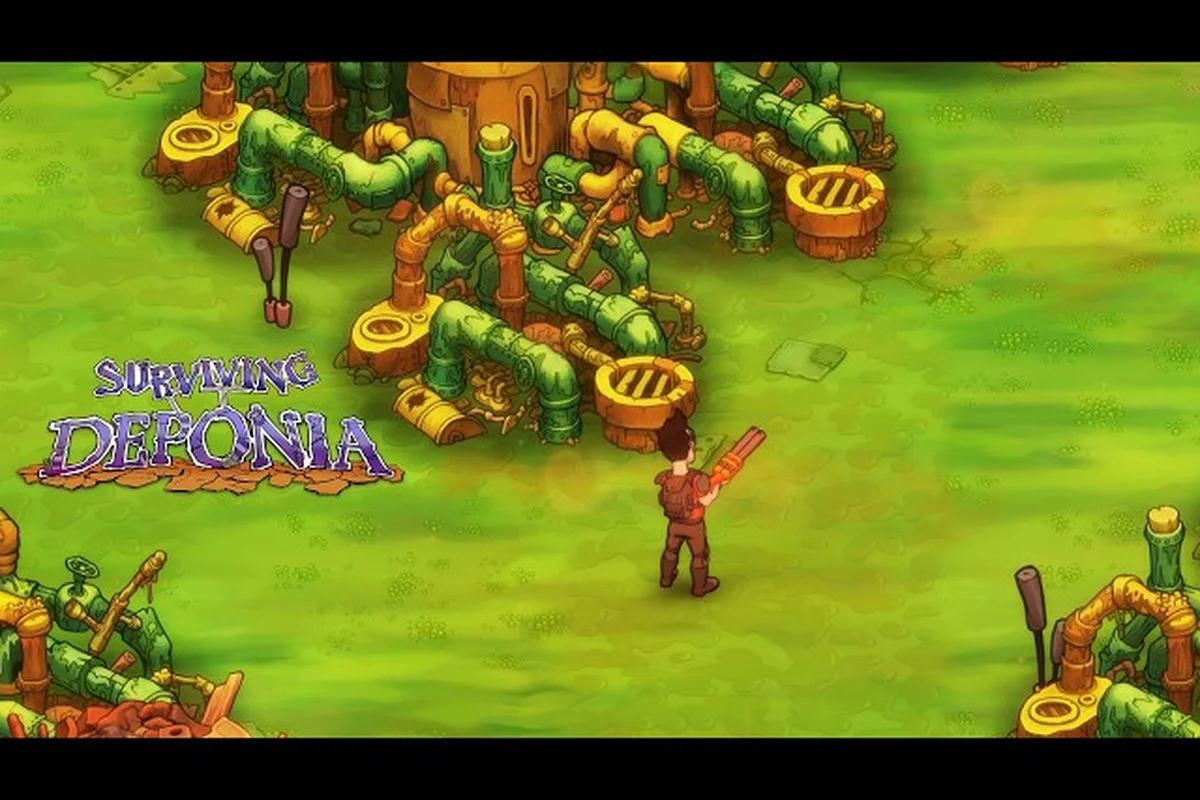
The upcoming 2026 release Surviving Deponia marks a bold pivot for the beloved point-and-click franchise, trading puzzle solving for full survival-crafting gameplay. Set seven years after the original trilogy, the game drops you into a Deponia left without clean water, where the surviving deponia features revolve around gathering trash, crafting tools, building shelter, and fighting off hostile creatures. This matters because the game represents Daedalic Entertainment's collaboration with AtomicTorch Studio, combining story-rich narrative with sandbox survival mechanics that veteran fans and newcomers alike will need to understand before diving in. Get the latest breakdown of what makes this survival experience distinct, from the water management systems to the resource economy that defines every play session.
Main Surviving Deponia Systems and Modes
The surviving deponia features combine classic survival genre staples with the quirky, satirical tone that made the original Deponia trilogy a cult favorite. According to the official Surviving Deponia Steam page, the game promises "explore, craft, build and fight your way through the harsh landscape of Deponia," which translates into four interlocking gameplay pillars. Players will scavenge the junkyard planet for usable materials, construct bases from salvaged scrap, craft everything from simple tools to advanced weapons, and defend their settlements against monsters, creatures, and hostile human factions that roam the wasteland.
What sets this apart from other survival titles is the narrative context. The game takes place after Elysium has crashed back onto Deponia, creating a never-before-seen water shortage that reshapes the entire world. This isn't just flavor text; the water scarcity mechanic drives exploration, base placement, and resource prioritization in ways that feel unique to the franchise. Players familiar with the series will recognize locations and lore references, while the isometric presentation and sandbox-flavored progression keep the experience accessible.
The core gameplay loop follows a familiar rhythm that survival veterans will recognize:
-
Scavenging phase — explore the procedurally varied landscape to locate trash piles, abandoned structures, and resource nodes
-
Crafting phase — convert raw materials into tools, weapons, building components, and water purification equipment
-
Building phase — construct and expand your base with defensive structures, storage, and crafting stations
-
Survival phase — manage hunger, thirst, health, and exposure while dealing with environmental hazards
-
Combat phase — engage in real-time fights against mutated creatures and hostile survivor groups
Each phase feeds into the next, and the surviving deponia crafting guide we will explore below becomes essential once you realize that nearly everything in the world is a potential resource. The trash that litters Deponia is not just set dressing; it is the lifeblood of your survival strategy, and learning to identify valuable salvage from worthless junk is the first skill you must master.
Water Scarcity and Resource Management Mechanics
The most distinctive mechanic in Surviving Deponia is the water scarcity system, which fundamentally changes how you approach resource management compared to other survival games. Because Elysium's crash disrupted the planet's already fragile ecosystem, clean water has become the rarest and most valuable commodity on Deponia. This design choice forces players to make difficult decisions about where to establish their base, how to allocate storage space, and which expeditions are worth the hydration cost.
Water affects every aspect of the survival loop. Your character's thirst meter depletes continuously, and when it runs dry, health regeneration stops, stamina decreases, and eventually you begin losing health. But water is also a crafting ingredient for cooking, a requirement for certain industrial processes, and a valuable trading commodity with NPC settlements. The interplay between personal consumption and crafting needs creates constant tension, especially in the early game before you unlock efficient purification methods.
| Water Source | Availability | Purification Required | Risk Level |
|---|---|---|---|
| Rain collectors | Low (rare storms) | Minimal | Low |
| Polluted puddles | Common | High | Medium |
| Underground wells | Very rare | Medium | High |
| Distillation units | Craftable | None | Low |
| Trade with settlements | Limited stock | None | Medium |
The surviving deponia water management system also ties into base building, since certain structures like distillation units require specific placement conditions. A well positioned near a polluted water source but with adequate ventilation can produce clean water efficiently, while a poorly placed unit might contaminate your entire supply. Community reports from early previews suggest that players who rush into building without planning their water infrastructure often find themselves in critical situations by day three or four.
Resource management extends beyond water, however. The game features a weight-based inventory system that limits how much you can carry, which means every scavenging expedition requires careful planning. You must balance bringing enough water and food to sustain the trip against the need to return with valuable resources. This creates a risk-reward loop where short expeditions to nearby trash piles are safe but yield modest returns, while longer treks to dangerous industrial zones offer rare components but require significant preparation.
| Resource Category | Examples | Primary Uses | Rarity |
|---|---|---|---|
| Common materials | Scrap metal, wood, cloth | Basic tools, building | Common |
| Advanced components | Circuit boards, rubber, glass | Electronics, water systems | Uncommon |
| Rare salvage | Motor parts, fuel cells, optics | Vehicles, advanced weapons | Rare |
| Organic matter | Food scraps, plants, bones | Cooking, medicine | Varies |
| Special items | Elysium tech fragments, relics | End-game crafting, lore | Very rare |
The surviving deponia resources economy rewards players who learn to identify high-value salvage quickly. According to community testing from the closed beta, experienced players can fill their inventory with valuable components in a fraction of the time it takes newcomers, simply because they know which trash piles are worth investigating. This knowledge gap is one of the reasons the crafting and scavenging system has such a steep learning curve, despite the accessible presentation.
Crafting Recipes and Construction Basics
The surviving deponia crafting guide breaks down into three distinct tiers, each unlocking progressively more complex recipes and requiring more specialized resources. The crafting system uses a blueprint-based progression where you discover new recipes by finding schematics, experimenting at crafting stations, or learning from NPC traders. This encourages exploration and provides meaningful rewards for thorough scavenging.
The early game focuses on basic survival tools — stone axes, crude knives, simple containers, and basic clothing. These recipes require only common materials and can be crafted at a simple workbench that you can build within the first hour of play. The mid game introduces refined production — metal tools, improved weapons, water purification units, and powered crafting stations that require electricity generated from salvaged generators. The late game unlocks advanced technology including automatic turrets, vehicle construction, and potentially even Elysium-derived equipment that references the original trilogy's sci-fi elements.
Crafting Stations and Their Requirements
Each crafting station serves a specific purpose and requires different materials to construct. Understanding the station hierarchy is crucial because it determines the speed and efficiency of your production.
| Crafting Station | Required Materials | Unlocks | Notes |
|---|---|---|---|
| Basic Workbench | Scrap metal (10), Wood (15) | Tools, simple weapons | Starting station |
| Forge | Stone bricks (20), Clay (10), Fuel | Metal tools, armor | Requires fuel source |
| Chemistry Station | Glass (5), Rubber (8), Circuit boards (3) | Medicine, water treatment | Mid-game essential |
| Electronics Bench | Circuit boards (10), Wire (15), Copper (5) | Electronics, turrets | Late-game technology |
| Vehicle Workshop | Motor parts (5), Fuel cells (3), Steel (20) | Vehicles, generators | End-game content |
Base building follows a similar tiered progression, starting with a simple shelter and expanding into a fortified compound. The building system uses a snap-based placement mechanic that allows for creative layouts while ensuring structural integrity. Walls, floors, roofs, doors, and windows can all be crafted from various materials, with stronger materials requiring more advanced crafting stations. Defense becomes increasingly important as you progress, since hostile creatures become more aggressive and human raiders may attempt to steal your resources.
The base building mechanics also include a settler system, where you can recruit NPCs to live in your settlement and assign them tasks like gathering, crafting, or defense. This ties directly into the surviving deponia characters aspect of the game, as each recruitable NPC has unique skills, backstories, and needs that affect their productivity. Some characters from the original trilogy make appearances, and their presence adds narrative depth to the survival gameplay. Players who want to understand the full roster and their backgrounds should check out the Surviving Deponia characters guide which details every confirmed character and their gameplay roles.
Crafting Priorities for Early Game Success
-
Day 1 priorities — craft a basic workbench, stone axe, water container, and simple bed. These four items establish your ability to gather, store water, and recover health.
-
Day 2 priorities — build a rain collector, upgrade to metal tools, and construct a basic shelter. The rain collector provides passive water generation that reduces your exploration pressure.
-
Day 3 priorities — unlock the chemistry station and craft water purification tablets. This allows you to safely consume polluted water sources, dramatically expanding your viable exploration range.
-
Day 4-7 priorities — establish a forge, begin producing metal components, and start fortifying your base against the escalating threat level.
The surviving deponia crafting guide emphasizes that tool durability is a critical factor in the early game. Every tool degrades with use, and repairing requires materials that might be scarce. Community data suggests that players who craft multiple backup tools before venturing into dangerous areas save themselves significant frustration, since a broken weapon in the middle of a creature attack can be fatal. This durability system forces you to balance crafting quantity against quality, since higher-tier tools last longer but require rarer materials.
Combat and Survival Strategies in the Wasteland
While crafting and building form the foundation of Surviving Deponia, combat mechanics are essential for surviving the hostile world. The game features real-time combat with a stamina-based action system that rewards tactical positioning and timing over button mashing. Different weapon types have distinct attack patterns, reach, damage, and stamina costs, creating a rock-paper-scissors dynamic where you must choose the right tool for each threat.
The enemy variety includes mutated creatures born from the pollution, aggressive scavengers defending their territory, and organized raider groups that may attack your settlement. Each enemy type requires different tactics, and understanding their behavior patterns is crucial for efficient combat. According to player reports from the beta, the creature AI is surprisingly sophisticated, with predators that track your scent, pack animals that flank, and human enemies that use cover and coordinate attacks.
Combat Tactics by Enemy Type
| Enemy Type | Weakness | Recommended Approach | Risk Rating |
|---|---|---|---|
| Trash Scavengers | Headshots, fire | Ranged weapons, kiting | Low |
| Mutant Hounds | Slashing damage | Shield + spear, parry | Medium |
| Poison Crawlers | Fire damage | Area weapons, distance | Medium |
| Raider Squads | Stealth, explosives | Ambush tactics, traps | High |
| Alpha Mutants | Armor-piercing ammo | Team coordination, turrets | Very High |
The survival strategies extend beyond combat, however. Environmental hazards play a significant role, with toxic zones, extreme weather, and radiation pockets all posing threats. Crafting protective gear like gas masks and hazmat suits becomes essential for exploring contaminated areas, and these items require advanced materials that are only found in high-risk locations. This creates a progression gate that naturally guides players toward mid-game content before tackling the most dangerous regions.
Base defense is another critical survival element, especially as the threat level escalates. The defense system allows you to place traps, walls, and automated turrets that engage enemies automatically. However, these defensive structures require maintenance and ammunition, creating an ongoing resource drain that must be balanced against other needs. Community testing suggests that a combination of layered defenses — outer walls, mid-range traps, and inner turrets — provides the best protection while minimizing resource expenditure.
The surviving deponia features also include a threat escalation system that steadily increases enemy aggression and frequency over time. This prevents players from turtling indefinitely and forces active engagement with the world. The escalation is tied to both time and player actions, so aggressive expansion and resource hoarding can accelerate the difficulty curve. Understanding this system is crucial for pacing your progression, and the Surviving Deponia survival guide covers the threat mechanics in detail with specific timing data.
Combat Equipment Progression
-
Tier 1 (Early) — stone club, crude bow, wooden shield. These basic tools provide minimal protection but are cheap to craft and maintain.
-
Tier 2 (Mid) — iron sword, crossbow, metal shield. A significant upgrade in damage and durability, requiring forge access and iron ingots.
-
Tier 3 (Late) — steel greatsword, repeating crossbow, tower shield. High damage output with substantial stamina costs, demanding careful stamina management.
-
Tier 4 (End-game) — Elysium energy weapons, power armor, advanced shields. Extremely rare and powerful, these items reference the sci-fi elements of the original trilogy.
The surviving deponia characters you recruit also affect combat effectiveness. Certain NPCs excel at specific combat roles, and assigning them to defensive positions can dramatically improve your base's security. Squad-based expeditions become viable once you have multiple combat-capable settlers, though this requires careful resource management to keep everyone equipped and supplied.
Water Management Deep Dive and Resource Economy
The water system deserves special attention because it is the most innovative mechanic in Surviving Deponia and the one that most dramatically differentiates it from other survival games. Rather than simply being a thirst meter to manage, water functions as a strategic resource that influences nearly every decision you make. The scarcity is intentional, designed to create tension and force meaningful trade-offs.
Water collection methods include passive systems like rain collectors and dew condensers, active methods like hand pumps and distillation units, and external sources like trade and exploration. Each method has different efficiency, maintenance requirements, and setup costs. The best approach combines multiple methods to create redundancy, since a single failed system can quickly become critical.
| Collection Method | Output/Day | Setup Cost | Maintenance | Best Use |
|---|---|---|---|---|
| Rain Collector | 5 units | Low | Minimal | Early game, passive income |
| Dew Condenser | 3 units | Medium | Low | Arid areas, supplement |
| Hand Pump | 10 units | Medium | Medium | Near water sources |
| Distillation Unit | 15 units | High | High | Polluted areas, large bases |
| Trade Network | Variable | Very High | None | Late game, stable supply |
The water purification chain requires multiple steps once you move beyond simple collection. Raw water must be filtered, then purified, then stored in clean containers. Each step requires specific equipment and can fail if conditions are wrong. Community testing has shown that contamination events can cascade, where a single contaminated batch ruins an entire storage tank, so proper system design is essential.
The resource economy extends beyond water, with each material having its own supply chain and uses. Understanding the resource interdependencies is key to efficient play. For example, producing steel ingots requires iron ore, coal, and a forge, but the forge requires fuel, which might compete with your cooking needs. These competing demands force prioritization and create interesting strategic decisions.
Resource trading with NPC settlements provides an alternative to self-sufficiency. Different settlements specialize in different goods, and establishing trade routes can provide access to rare materials you cannot produce yourself. However, trade requires surplus resources to exchange, which means you must produce more than you consume in at least one commodity. The surviving deponia resources economy rewards specialization, since focusing on a few high-value products and trading for your other needs is often more efficient than trying to be self-sufficient in everything.
Advanced Water Strategies
-
Water banking — maintaining excess water storage for emergencies, since droughts and contamination events can disrupt production
-
Decentralized collection — placing multiple small collectors across your territory instead of one large system, reducing vulnerability to single-point failures
-
Grey water recycling — reusing water from cooking and crafting for non-potable purposes like cleaning and irrigation
-
Settlement water trading — establishing water surplus and using it as currency for acquiring rare materials
Players interested in the deeper strategic layers should also explore the Deponia series lore guide, which explains how the events of the original trilogy connect to this survival sequel. The water crisis is directly linked to Elysium's crash, and understanding the lore adds meaningful context to your survival objectives.
Frequently Asked Questions
What are the most important surviving deponia features to learn first?
The most critical surviving deponia features are water management, resource identification, and basic crafting. Master these three systems before focusing on combat or advanced building. Water scarcity drives everything else, so learning to secure a reliable water supply should be your first priority when starting a new game.
How does the surviving deponia water system differ from other survival games?
The surviving deponia water system is more integrated into the overall gameplay loop than typical survival games. Water is not just a personal thirst meter; it functions as a strategic resource affecting crafting, trading, base building, and exploration. The scarcity is a core design element tied directly to the game's story, making it a unique mechanical and narrative feature.
What should I prioritize in a surviving deponia crafting guide for beginners?
Beginner players should prioritize crafting basic tools, water collection equipment, and a simple shelter within the first few days. Focus on the basic workbench, stone axe, water container, and rain collector before expanding into more advanced crafting. These foundational items establish your ability to gather resources and sustain yourself.
Which surviving deponia characters are most useful for base building?
The most useful surviving deponia characters for base building are those with high construction and engineering skills. These characters craft faster, use fewer materials, and can construct advanced structures. However, character effectiveness also depends on their morale and needs, so maintaining good living conditions is essential for maximizing their productivity.
How does the surviving deponia lore connect to the original trilogy?
Surviving Deponia is set seven years after the trilogy, when Elysium crashes back onto Deponia, triggering the unprecedented water shortage that drives the survival mechanics. You will revisit recognizable locations and characters, but the lore reframes them through the new scarcity economy—so familiar faces now gate access to crucial water and crafting resources.